
The 8D Survival Guide. Built for What Happens Under Pressure.
How Automotive Suppliers Respond to Customer Claims, Escalations, and OEM Pressure. A practical working guide for quality professionals and manufacturing teams who need to protect the customer, control the evidence, prove root cause and close claims with confidence.
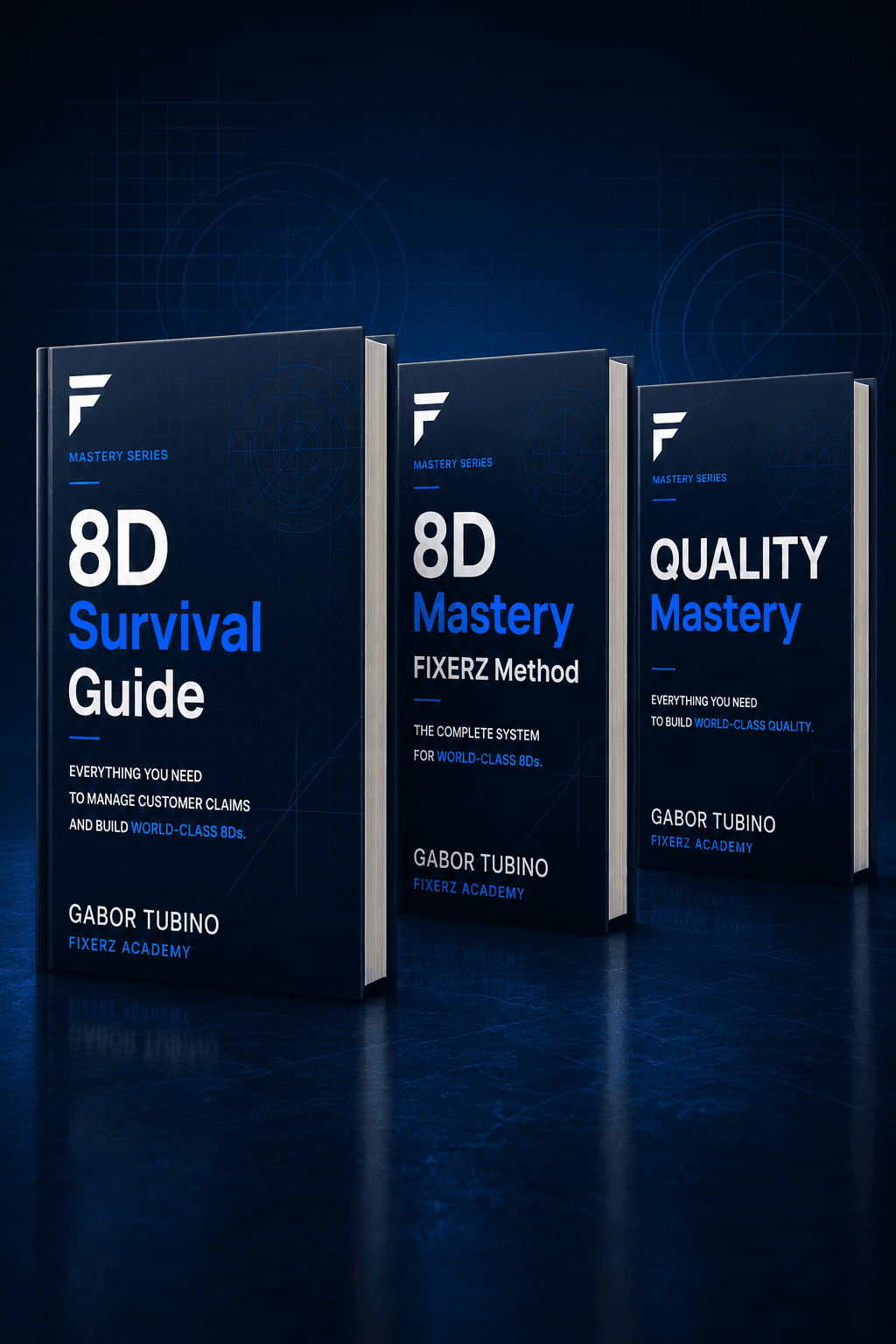
Most Teams Already Have an 8D Template. That Is Not the Same as Having Control.
The 8D Survival Guide was written for the moment when a customer claim becomes real: the customer wants an answer, production wants to continue, logistics has material moving, the root cause is not yet known and management wants visibility.
It connects the technical 8D disciplines to the wider claim-management system behind them: claim intake, risk classification, containment, evidence, communication, corrective action, document updates, escalation and closure.
Before the 8D. During the 8D. After the 8D.
The structure follows the real flow of an automotive customer claim and the decisions that determine whether the supplier regains control.
Written for the People Who Have to Answer the Customer.
The book is intended for people working inside the supplier-side reality of automotive manufacturing.
Quality Engineers & Managers
Strengthen claim control, evidence, root cause, corrective action and customer-ready communication.
Production, Logistics & Supplier Quality
Understand how each function affects containment, traceability, evidence and claim closure.
Plant & Manufacturing Leaders
See the wider business risk behind customer claims, escalation, cost and repeat failures.
The Book Is the Foundation. FIXERZ Builds the Operating Capability Around It.
Use the book alone as a reference, or connect it to training, tools and implementation support.
8D Training
Apply the body of knowledge through practical professional and company training.
Explore Training →8D Master File
Turn the method into a controlled claim-response working structure.
Explore Master File →Claim Tracker
Make status, actions, owners, deadlines and escalation exposure visible.
Explore Claim Tracker →8D Templates
Use editable forms, checklists and review tools connected to the method.
Explore Templates →Practical, Not Academic.
Is this only a book about the eight disciplines?
No. It covers the wider customer-claim system around the 8D, including intake, customer protection, evidence, logistics, supplier cross-claims, communication, escalation and controlled closure.
Can it be used during a live customer claim?
Yes. It is designed to work as a reference tool as well as a book that can be read from beginning to end.
Does the book replace training or company procedures?
No. It provides a practical body of knowledge. Training, company-specific rules and controlled working tools remain separate layers of capability.
Build the Discipline Before the Next Claim Arrives.
Start with the practical body of knowledge, then move into training, tools or direct customer-claim support.

