
Why I Wrote The 8D Survival Guide and Why I Built FIXERZ Academy
After decades in manufacturing, I became increasingly convinced that the industry did not have a shortage of procedures. It had a shortage of practical knowledge that people could actually use when things went wrong.
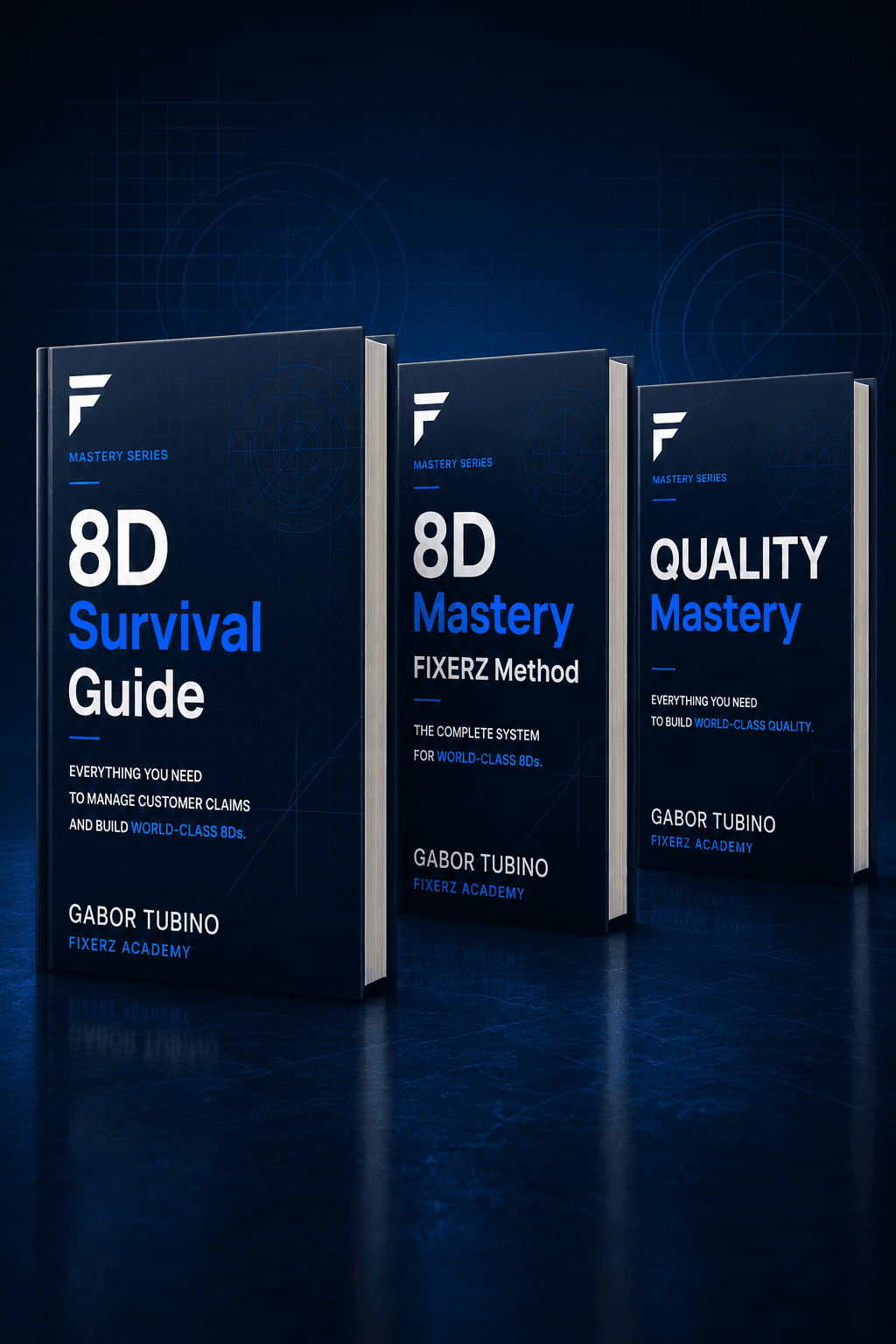
I did not write The 8D Survival Guide because manufacturing needed another explanation of D1 through D8. I wrote it because, throughout my career, I repeatedly found that practical 8D problem solving knowledge was fragmented precisely when manufacturing teams needed it most.
There were already books, presentations, templates, procedures, quality manuals and thousands of pages online explaining the theoretical structure of 8D problem solving.
What I could not find was the resource I had needed throughout my own career.
A resource that answered the questions that appear when the presentation ends and the real customer claim begins.
That distinction matters.
For more than three decades, my professional life has been shaped by manufacturing, leadership, supply chain, quality, Lean, Six Sigma, crisis management and the operational realities of complex industrial organisations. Over those years, I repeatedly encountered situations where the methodology existed, the procedures existed and competent people were sitting around the table.
And yet the organisation was still struggling to regain control.
That contradiction stayed with me.
The Questions Were Never as Simple as the Training Slides
In a classroom, problem solving is beautifully sequential.
In manufacturing, it rarely is.
A customer complaint arrives while production is running. Logistics needs to know what can still be shipped. Production wants to understand whether the line must stop. Quality is trying to establish the population at risk. Engineering is investigating the technical failure. Management wants an accurate status. The customer wants containment, evidence and confidence.
Often all of this is happening simultaneously.
That is when the real questions begin.
What do we know? What do we only assume? Where is the risk? How far could the defect have travelled? What evidence is strong enough to support a decision? When does containment become credible? How do we distinguish the cause of occurrence from the cause of escape? And how does an organisation demonstrate that it has genuinely regained control?
These were the questions I wanted answered during my own career.
Too often, I found fragments.
One source explained 5 Why. Another explained Ishikawa. Another described the eight disciplines. Another provided a template. Another discussed corrective action.
But manufacturing does not experience these subjects as isolated concepts.
They arrive together.
A customer claim is an operational event. It crosses departments, information systems, responsibilities, priorities and management levels. The quality of the response therefore depends on far more than whether somebody knows how to complete an 8D form.
Knowing 8D and Operating 8D Are Not the Same Capability
This became one of the central ideas behind the book.
There is an enormous difference between knowing the methodology and being able to operate it under pressure.
A technically complete document can still represent a weak investigation.
A root cause can sound perfectly plausible and still be unsupported by evidence.
A corrective action can be implemented and still fail to address the actual failure mechanism.
A team can close an 8D while leaving the process conditions that created the defect completely intact.
Documentation is evidence of the system. It is not the system itself.
A strong customer claim response requires operational discipline, cross-functional ownership, risk-based thinking, evidence management, structured decision-making and effective leadership communication.
When those elements are weak, the weakness eventually becomes visible.
Sometimes it appears as a rejected 8D.
Sometimes as recurring defects.
Sometimes as emergency sorting, premium freight, controlled shipment or escalating customer pressure.
Sometimes it appears months later when everyone believed the problem had already been solved.
The report may have been closed.
The system was not.
Then I Tried to Find Complete Training for My Own Teams
The same frustration appeared when I looked for training.
I was not looking for a few hours of theory.
I wanted something I could give to a manufacturing team and confidently say: after this, they will understand how to manage the complete customer-claim environment.
Not simply how to recite the eight disciplines.
I wanted the relationship between customer protection, containment, problem definition, root cause analysis, escape analysis, corrective action, verification, prevention, standardisation and management communication to be taught as one connected operating system.
I wanted Quality to understand Production.
Production to understand the implications of containment.
Logistics to understand traceability and customer exposure.
Engineering to understand the evidential standard required for root cause.
Management to understand what questions to ask before accepting that the problem was under control.
A defect may be technical. The response is organisational.
That complete training was remarkably difficult to find.
There was excellent material in individual disciplines. There were knowledgeable trainers. There were established methodologies.
What I could not find was the complete, practical architecture I wanted.
Eventually, I reached a fairly simple conclusion.
If I could not find it, I would build it.
That Decision Became The 8D Survival Guide
The book began as an attempt to organise decades of practical knowledge into something useful.
Not an academic description of 8D.
Not another template with eight boxes.
A working body of knowledge.
I wanted to connect the method to the reality surrounding it: customer trust, risk, containment, escalation, evidence, leadership, communication, organisational behaviour, process control and recurrence prevention.
Because that is what professionals actually confront.
The objective was never simply to help somebody write a better report.
It was to help people think better while building the report.
To know when evidence is weak. To challenge assumptions. To separate facts from hypotheses. To understand risk before discussing explanation. To recognise when an apparently convenient root cause is not a root cause at all. To connect corrective action to the process conditions that enabled the failure. And finally, to prove that the result is effective rather than merely declaring that the action is complete.
The 8D Survival Guide
A practical resource for professionals responsible for customer claims, root cause analysis, corrective action and evidence-based 8D problem solving in real manufacturing environments.
Buy on Amazon →The Book Eventually Exposed a Bigger Need
As the structure grew, something became increasingly obvious.
A book could transfer knowledge.
It could not, by itself, create professional capability.
Capability requires application.
It requires practice.
It requires people to make decisions, explain their reasoning, defend conclusions, recognise weak evidence and experience the consequences of choosing the wrong path.
That realisation eventually became FIXERZ Academy.
The Academy exists because I wanted to build what I had spent years searching for: a connected professional development environment for manufacturing quality and operational excellence.
The book provides the body of knowledge. Training develops application. Practical exercises build judgement. Working tools connect learning to daily operations. Assessment establishes whether somebody can understand, apply, communicate and defend the method. Implementation converts knowledge into standard work.
That progression is deliberate.
Because attending training is not the same as developing capability.
And capability is ultimately what manufacturing organisations need.
Quality Is an Operating System
There is another reason FIXERZ exists.
For too long, organisations have treated quality as a department rather than an operating philosophy.
Quality becomes far more powerful when it is embedded in how an organisation manages risk, communicates, escalates, solves problems, validates decisions, learns from failure and improves its processes.
That is the philosophy behind FIXERZ.
Lean contributes discipline and flow.
Six Sigma contributes evidence and analytical thinking.
Structured problem solving creates logic.
Crisis management brings control under pressure.
Leadership establishes accountability.
Standard work sustains the result.
Continuous improvement prevents the organisation from returning to the conditions that produced the failure.
These are not separate management fashions.
Properly connected, they form an operating system.
I Built What I Had Been Looking For
Looking back, the reason for writing The 8D Survival Guide is therefore quite personal.
I spent years asking questions for which the available answers were often incomplete, fragmented or disconnected from the realities of manufacturing.
Later, when I wanted to develop other people, I encountered the same problem from another direction.
I could find training.
I could find templates.
I could find methodologies.
What I struggled to find was one coherent system connecting knowledge, judgement, evidence, operational discipline and implementation.
So I stopped looking for it.
I started building it.
The book was the first step.
FIXERZ Academy is what came next.
To build professionals and organisations that do not simply know the language of quality, but know how to operate quality when it matters.
Manufacturing Quality • Operational Excellence • Crisis Management • Lean • Six Sigma
Move From Knowledge to Practical Capability.
Explore the professional development, company training, assessment and expert-support pathways connected to the FIXERZ manufacturing quality system.
8D Training
Develop practical customer-claim, root cause, corrective-action and quality leadership capability.
Explore 8D Training →Professional Diploma
Develop and demonstrate deeper professional judgement through structured learning and assessment.
Explore the Diploma →For Companies
Build one cross-functional operating discipline across Quality, Production, Logistics, Engineering and Management.
Explore Company Training →Claim Rescue
Bring independent expert challenge into rejected 8Ds, recurring problems and customer escalation.
Explore Claim Rescue →

Leave a Reply